Transform Your Smile with Ahwatukee Dental Implants at Dentique
A missing tooth changes more than a photograph. It changes which side of your mouth you chew on, how clearly certain words come out, and how often you catch yourself covering your smile mid-conversation. Left alone, the jawbone under the gap starts to shrink, the neighbouring teeth drift, and the tooth above or below over-erupts. A one-tooth problem quietly becomes a three-tooth one.
Dental implants stop that chain reaction. A small titanium post is placed into the jawbone where the root used to be, bone grows onto it, and a custom crown is fitted on top. The result is a tooth you brush, floss and bite with normally — one most patients stop thinking about within a few weeks.
Our office sits in the Ahwatukee Foothills at 15715 S 46th St, Suite 104, Phoenix, AZ 85048, so patients from Mountain Park Ranch, Club West, Lakewood, Foothills Reserve and The Foothills are usually here in under ten minutes. We also see patients from Chandler, Tempe, Laveen and South Phoenix, across zip codes 85044, 85045, 85048, 85226 and 85286.
Why Ahwatukee Patients Choose Us for Implants
One dentist from the first scan to the final crown
Most practices split implant treatment in two: an oral surgeon places the post at one office, then a general dentist restores it at another. Every handoff is a chance for the final crown to sit slightly off, and a chance for nobody to own the outcome. Dr. Bhatnagar performs both the surgical placement and the restoration in-house. One clinician plans your case, places your implant, and fits the tooth you walk out with.
3D-guided placement, not freehand
Every implant case begins with a cone beam CT scan. That 3D volume shows exact bone height, bone density, the position of the inferior alveolar nerve and the floor of the sinus — detail a flat 2D X-ray simply cannot render. We use it to build a digital surgical guide, so the implant is placed at a pre-planned angle and depth rather than judged by eye during surgery.
Credentials you can check
Dr. Rashmi Bhatnagar holds a Mastership from the Academy of General Dentistry a distinction earned by roughly the top two percent of dentists nationally, requiring more than 1,100 hours of documented continuing education. She has been named a Phoenix Magazine Top Dentist in multiple consecutive years. Her Arizona dental license is verifiable through the Arizona State Board of Dental Examiners.
Sedation for patients who are genuinely anxious
Anxiety is one of the main reasons people live with a gap for years rather than months. Sedation dentistry is available for any stage of implant treatment, though most single-implant placements are completed comfortably under local anaesthetic alone.
More than 450 five-star reviews
Patients consistently describe the same two things: that the procedure was easier than they expected, and that they wish they had done it sooner. [Add two or three specific implant reviews here, first name and neighbourhood only.]
What Is a Dental Implant?
A dental implant is a three-part tooth replacement:
- The implant — a small screw-shaped titanium post placed into the jawbone, taking over the job of the natural root.
- The abutment — the connector fitted onto the implant once healing is complete.
- The restoration — the visible crown, bridge or denture, shade-matched to the teeth around it.
What separates an implant from a bridge or a denture is osseointegration: over roughly three to six months, living bone grows directly onto the titanium surface and locks the post in place. That biological bond is why an implant transmits chewing force into the jaw the way a real root does — and why it is the only tooth-replacement option that actively preserves the bone underneath the gap instead of watching it disappear.
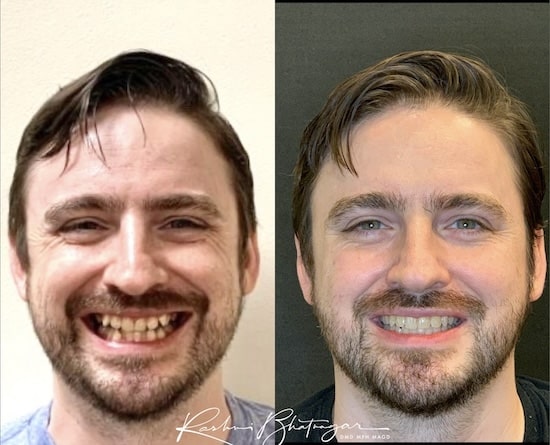
Benefits of Tooth Implants
Dental implants can offer benefits in multiple different areas of your life! Some of those benefits include:

A Complete Smile
Implants will restore your smile by filling in the gaps created by missing teeth. With your smile intact, you will look and feel great again.

A Stronger Jaw
Implants support the surrounding jawbone, maintaining bone height and preventing jawbone deterioration.

Improved Health
Replacing missing teeth will aid in eating, speaking, and smiling more. Increased self-confidence boos
Implant Treatments We Provide
Single tooth implant
One implant, one crown, for a single missing or unrestorable tooth. Unlike a traditional bridge, it does not require grinding down the two healthy teeth on either side of the gap.
Implant-supported bridge
Two implants carry a bridge spanning three or more missing teeth in a row fewer implants than teeth, and a lower total cost than replacing each tooth individually.
Full-arch implants (All-on-4 and All-on-6)
Four to six implants support a complete fixed arch. This suits patients who have lost most or all teeth in one jaw and want teeth that stay in permanently rather than coming out at night.
Implant-retained overdenture
Two or more implants anchor a denture with snap-in attachments. The denture still comes out for cleaning, but it stops sliding, clicking and rocking — the single most common complaint about conventional lower dentures.
Supporting procedures
- Bone grafting — rebuilds jawbone width or height where it has already resorbed.
- Sinus lift — raises the sinus floor to create room for upper back implants.
- Socket preservation — a graft placed at the moment of extraction to keep the site implant-ready.
- Implant repair — replacing a worn, chipped or failed crown on an existing implant.
The Dental Implant Process, Step by Step
- Consultation and 3D scan. A CBCT scan, digital impressions and a clinical exam establish bone density, nerve position and bite. You leave with a written plan and an itemised quote before anything begins.
- Preparation, if needed. Extraction of a failing tooth, a bone graft or a sinus lift is completed first. Grafted sites typically heal three to six months before the implant goes in.
- Implant placement. Roughly 60 to 90 minutes per implant under local anaesthetic, with sedation available. The guided channel is prepared and the implant seated. Most patients are back at a desk the next day.
- Osseointegration. Three to six months for bone to fuse to the implant — usually faster in the lower jaw. A temporary tooth keeps your smile complete throughout.
- Abutment and final impression. Once integration is confirmed, the abutment is fitted and a digital scan taken for your restoration.
- Final restoration. The custom crown, bridge or arch is fitted, the bite refined, and photographs taken for your record.
- Maintenance. A review at [interval], then implant-specific hygiene visits every six months for life.
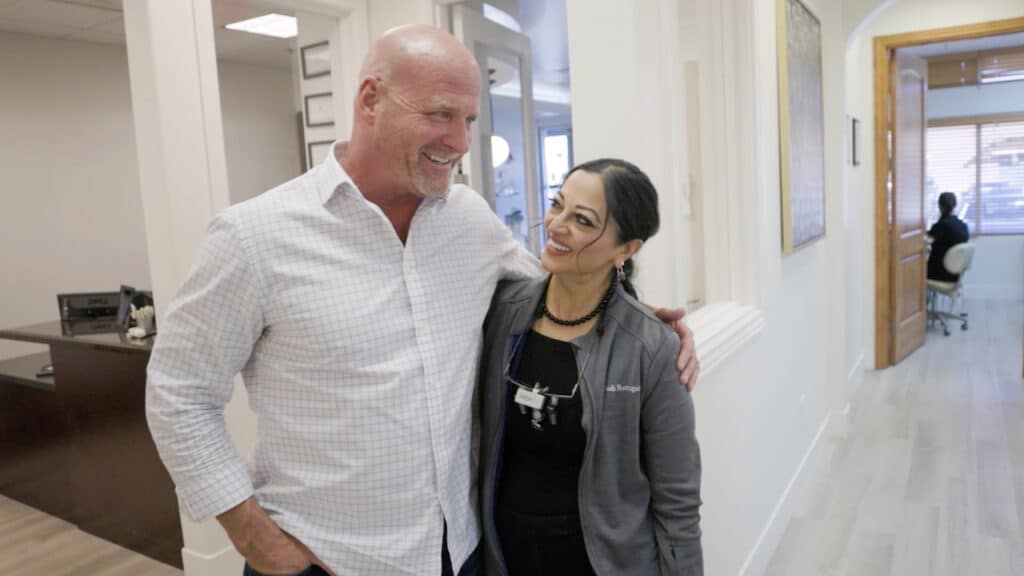
Serving Ahwatukee and the Surrounding Communities
We are located at 15715 S 46th St, Suite 104, Phoenix, AZ 85048, in the Ahwatukee Foothills, with parking directly outside and easy access from Chandler Boulevard, Ray Road, 48th Street, Desert Foothills Parkway and the I-10.
Nearby cities: Chandler, Tempe, Laveen, South Phoenix, Maricopa, Avondale
Frequently Asked Questions